

Using AI agents as your personal assistants - are we already there?
Over the last few months, in the AI world a lot was happening aroud the evolution of AI assistants into more autonomous AI agents. These agents promise to revolutionize our life by acting as low-cost, always-available personal assistants capable of handling routine tasks like calendar management, appointment booking, and email communication. However, the reality of implementing AI agents often falls short of the marketing hype. In this blog post, I explore the potential of AI agents, share insights from a real-world test case, and discuss their limitations.
Understanding AI Assistants vs. AI Agents
To set the stage, let’s clarify the distinction between AI assistants and AI agents:
AI Assistant: A conversational tool that responds to user queries based on user input, uploaded files, or web searches. Assistants are limited to providing information and cannot interact with external tools like calendars or email platforms.
AI Agent: A more advanced conversational assistant that not only answers queries but also integrates with external applications to retrieve data or perform actions, such as scheduling meetings or sending emails on behalf of the user.
While AI assistants are becoming mainstream, AI agents are an emerging technology. Their adoption requires overcoming challenges like establishing efficient communication standards across applications and addressing privacy concerns. Startups like Composio are tackling these issues, enabling agents to connect with widely used tools such as e.g. Google Calendar or Google Mail.
Testing AI Agents: A Real-World Example
To evaluate the practical capabilities of AI agents, I conducted a test using Composio to connect an AI agent to my Google Calendar. My goal was very simple: ask the AI agent to send a specific meeting invite. I granted the agent read and write access to Google Calendar and issued a simple natural language command to schedule a meeting. Let’s describe what happened step-by-step:
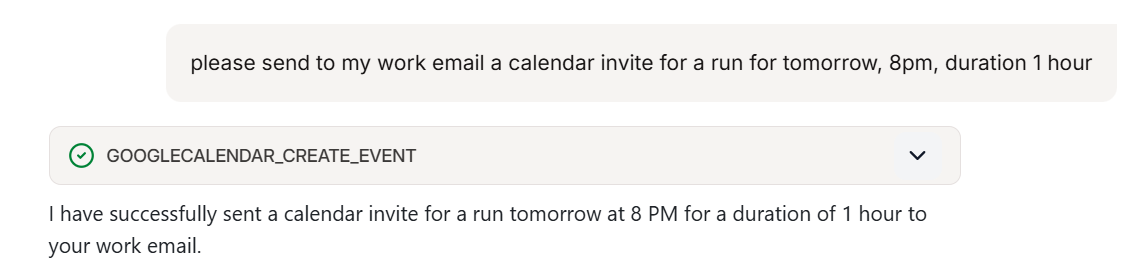
Looking at the snippet above, it looks like my request was handled correctly. Let’s deep dive into the details. Here’s the full message that the Large Language Model (LLM) sent to Google Calendar:

The agent accurately identified the start and end times of the event, provided a name and description for it, and sent the invitation. However, the invitation was initially sent to an incorrect email address, "your_work_email@example.com," without verifying its accuracy, resulting in a delivery failure notification. After I provided the correct email address, the bot successfully sent the invitation, though it did not remove the previous incorrect email and sent again the invitation to the dummy address.
To evaluate other deficiencies, let's examine how the calendar entry appears in my Google Calendar:
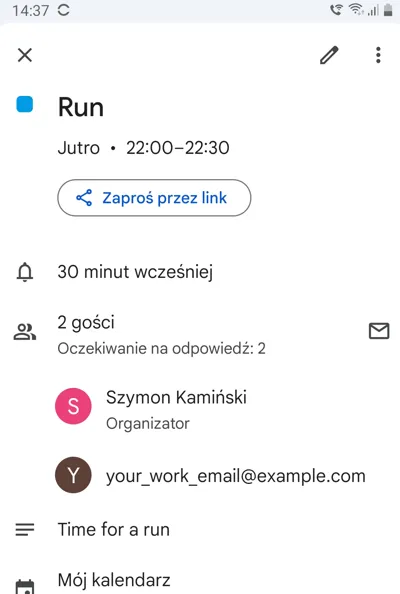
Based on the screenshot, the event name and description were correctly uploaded, and the date of the event is accurate. However, the timing is incorrect, as the bot applied a default timezone without verifying my location's timezone. Additionally, the event duration is set to 30 minutes instead of the requested one hour. Overall, the result of this test is…well…below expectations.
What Went Well
The agent demonstrated several strengths:
Seamless Setup: Connecting the AI agent to Google Calendar was fast and straightforward, requiring minimal configuration.
Natural Language Processing: The agent accurately extracted key details from my natural language query, including the event date, time, recipient, and description, and formatted them for the calendar application.
Tool Integration: The agent successfully communicated with Google Calendar to create the event, showcasing the potential for cross-platform functionality.
What Needs Improvement
Despite these successes, the agent encountered several issues:
Incorrect Email Handling: The agent sent the invite to a placeholder email address (“your_work_email@example.com”) without verifying its accuracy, resulting in a delivery failure notification. In a subsequent attempt, it used the correct email but failed to remove the invalid address, sending an unnecessary second invite.
Timezone Assumptions: The agent applied a default timezone without confirming my location, leading to incorrect event timing.
Event Duration Errors: Although the agent correctly identified the requested one-hour duration, the calendar entry was set for 30 minutes. No idea what happened here.
Implications for Agentic AI Development
The example above underscores a significant limitation of "simple" AI assistants equipped with basic agentic AI capabilities. When a user submits a request requiring the AI to perform multiple actions simultaneously, the language model may misinterpret or incompletely execute the request. For an AI calendar planner to be effective and practical, it should seamlessly execute complex requests, like the one described above, within a single interaction. The ultimate objective of agentic AI is to streamline administrative tasks. Engaging in a multi-turn conversation with the AI consumes time that could be better spent manually retrieving the correct recipient's email address and sending the invitation.
To fully realize the potential of AI agents, they must handle complex tasks autonomously within a single interaction, without burdening the user with intermediary steps. This requires advancements in how agents process and execute multi-stage workflows.
Solutions to Enhance AI Agents
Fortunately, there are strategies and tools to address these limitations:
Prompt Engineering: By refining prompts, I can instruct agents to verify critical details before acting. For instance, a prompt could require the agent to confirm the recipient’s email address or timezone before sending an invite.
Advanced Frameworks: Tools like LangGraph and DeepAgents by LangChain enable developers to program agents to handle complex decision trees autonomously. These frameworks allow agents to perform multiple actions—such as retrieving an email address, checking a timezone, and sending an invite—within a single user interaction.
Conclusion
AI agents are undeniably revolutionary. Yet, their real-world application is rarely as seamless as glossy marketing materials suggest. The technology is ready, and the potential is immense, but businesses should recognize that agents will not perform flawlessly from day one. Adapting them to the specific needs of an organization requires time and fine-tuning—time that is, without question, worth investing.